Once upon a time, Fujifilm Holdings was in the same boat as Eastman Kodak, enjoying a near-monopoly market position in photographic film. But Fujifilm’s more expansive view of its business has been enormously successful, whereas Kodak failed, filing for bankruptcy in 2012.
Fujifilm invested heavily in medical imaging, leveraging existing chemical technology and know-how that the firm used in photographic film, launching a full product line of diagnostic equipment for hospitals and other healthcare providers. The company also developed and marketed pharmaceutical drugs using existing chemical compounds. While its revenue has declined, profits have turned from losses to healthy margins. As of 2010, the company didn’t break out healthcare as a separate business, except for noting that its X-ray film technology has been a mainstay of the company since the 1930s. Currently, 18% of Fujifilm’s $22 billion in revenue comes from healthcare.
In a similar way, Schneider Electric leveraged its ability to create tech platforms to move into creating an Internet of Things data analytics business for energy management. Finland’s Neste seized on the market for renewable biofuels using some of the same industrial processes that it honed for refining oil & gas.
China’s Ping An leveraged its know-how and industry relationships as a traditional health insurance company to launch an online healthcare ecosystem platform called Good Doctor. The advantage of incumbency paid off, as Good Doctor signed up over 3,000 hospitals, 1,000 health clinics, 500 dental clinics and 7,5000 pharmacies. This critical mass has attracted more than 265 million registered users, enabling Ping An to stage an IPO of the platform as a separate company, raising over $1 billion from global investors.
They seize the digital opportunity via new platforms and business models.
For DBS Bank, the transformation has been along many dimensions, from a national bank to a regional and global bank, and from traditional banking services to new kinds of fintech business models. But the common denominator to all these efforts has been building new digital platforms, says Paul Cobban, Chief Data Transformation Officer. “We went public with an economic model that would determine the value of our digital strategy,” Cobban says. “So we can measure how much value we’re getting out of this approach.” Some powerful results: In 2019, DBS became the first bank to simultaneously hold the titles “Bank of the Year” (The Banker), “Best Bank in the World” (Global Finance), and “World’s Best Bank” (Euromoney). One of the keys to that success was not just going digital but opening up a digital platform that others can play on, taking part of the playbook from companies like Apple, Adobe and Amazon. DBS launched the world’s largest application protocol interface (API) protocol, where financial and retail partners can invisibly integrate DBS’s capabilities into their systems. By late 2018, DBS demonstrated that digital customers are at least twice as profitable as traditional customers.
Netflix mines audience data to create an astonishing range of new shows. Not only does Netflix use data to drive the compelling customer experience (e.g. even tailoring the images they use for each show to match customer preferences), they have fundamentally changed the way that they make decisions about which shows to pursue based on the data they collect on viewing behavior. For example, there are numerous stories of potential showrunners (e.g. The Crown) arriving to meet Reed Hastings thinking they were there to pitch the show only to discover that Netflix had used data to already make the decision about pursuing the show based on their own analytics.
AIA Group’s transformation has taken the Hong Kong-based life insurance company into a new global growth area, with its digital Vitality platform providing wellness and prevention knowledge, tools, and motivation to AIA members, leading to a business representing 10% of total revenue and growing at an 85% rate last year. Other T20 firms have also reaped benefits of invested heavily in new digital platforms for its customers.
Cisco has cultivated customer relationships to find smart niches for new value-added digital subscription services. Ecolab has created new digital platforms for water analytics and distribution.
Innovation isn’t isolated to a department but is a strategic capability.
Jeff Bezos of Amazon.com has famously led the organization to obsess over the customer, rather than competitors, leading to the Internet retail to take its internal cloud technology to customers. Amazon Web Services is now a $26 billion business that provides a lion’s share of the company’s profits.
In a similar way, Alibaba has always made innovation the key to everything, enabling it to expand beyond its roots as an e-commerce and Internet services company into new growth areas ranging from digital platforms for financial services to digital media to AliHealth and AliSports.
At Microsoft, CEO Satya Nadella has built a different kind of culture of innovation, less technological and more customer-focused, than the company led by his predecessors.
This was accomplished largely by shifting its culture away from one of competition, where managers were told to rank the value of each employee from 1 to 5. Nadella came up through the organization by growing its Azure cloud business by asking questions about customer needs. “We went from a culture of know-it-alls to a culture of learn-it-alls,” says Chris Capossela, Microsoft’s chief marketing officer.
These cultural traits of curiosity and customer obsession are hallmarks of innovative organizations, and it’s precisely this behavior that helps a large organization pivot to a growth mindset.
By many accounts, this has served the organization well as it moved away from its obsolete mission of “a computer on every desktop,” which was technology-focused, to its current mission of “empower every person and every organization on the planet to achieve more,” which is customer-focused.
Ørsted’s Poulsen encapsulates this innovation mindset like this: “We didn’t want to have a corporate innovation department or R&D group but to have innovation out in all the business units, so we can innovate offshore wind as a technology, in the supply chain; in the way we design, operate and maintain, to innovate every aspect, including our partnership business model.”
Seven Transformations to Watch
These finalist companies advanced into the third round of the analysis but fell short in the judge’s ratings to make the T20. In some cases, these companies are only just recently embarking on their transformation journey. For instance, Italian energy giant Enel only began in 2017 to embark on its strategy for smart homes and sustainability services. Others, like Danone (a previous T10 company, for its shift to becoming a nutrition-focused firm), have executed long-running transformations that haven’t yielded new levels of change in recent years. Yet all of these firms remain impressive, considering that more than 95% of public companies haven’t attempted to transform or haven’t achieved measurable new growth.
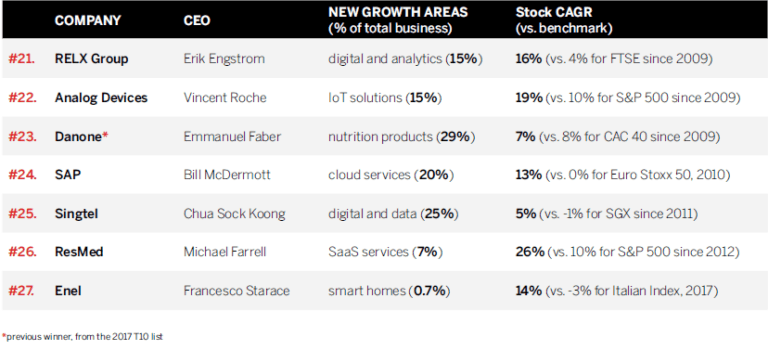
The 27 finalists firms are headquartered around the world
Conclusion: overcoming the crisis of complacency
The takeaway lesson from these mission-changers is clear: In an era of relentless change, a company survives and thrives based not on its size or performance at any given time but on its ability to reposition itself to create a new future. The leaders of the companies we’ve featured here have to varying degrees steered through different types of organizational crises.
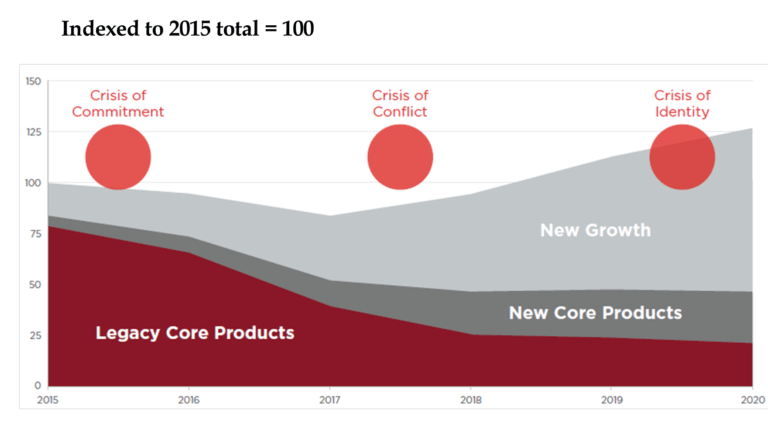
As outlined in Dual Transformation (see graphic below), there are three flash points that happen as an organization change effort is proceeding successfully but can derail the entire plan:
Crisis of Commitment: when at the early stage of a transformation, many leaders and employees worry about committing to a new trajectory and seeing it through even in the face of evidence that the core is in decline.
Crisis of Conflict: when different parts of the organization fight for scarce capital resources as new growth areas receive a disproportionate share of investment relative to their current size. What happens when key stakeholders complain that new growth progress is too slow?
Crisis of Identity: when the organization realizes “If we’re not a [fill in the blank] company anymore, what are we? What happens if key people feel like they don’t belong anymore?
However, the vast majority of leadership teams never encounter these three crises. As a chief technology officer we met with recently asked us: “We basically aren’t at any of these stages yet. What do you call the crisis before all of this?”
That caused us to step back to consider what prevents most companies from making the decision to transform in the first place. We’d call this the Crisis of Complacency. One driver of this crisis is that existing data misleads because it lags the disruption taking place in the market. By the time the data is clear, it is typically too late. A second problem is that existing customers often serve as poor guides to the future, as they tell companies to provide them better, cheaper versions of what they are currently providing. A final driver of complacency is the constraints that an existing business model places on a company.
Mirroring Netflix’s subscription-based business model, for example, looked financially unattractive to Blockbuster Video, who made most of its money via charging late fees. The lessons are counter-intuitive yet clear:
Data misleads.
Customers deceive.
The business model binds.
This places companies in the prison of the present, where they perpetuate the past versus creating the future. It takes courage to choose the difficult path of breaking out of this prison and challenging the status quo.
Which brings us to the most common argument we encounter when it comes to embarking on transformation: it’s too risky. But as one Fortune 500 CEO recently told us, “Our system of capitalism totally misprices risk. Big moves look like they are really risky. But by and large they are not. Because what you lose when you invest a ton of money is the money you invested. It is capped. However, when you win, you create not only an annuity but a new ecosystem that gives you the opportunity to grow in new areas for a long time to come.”
The Transformation 20 indeed shows the powerful payoff that comes when leaders steer their organization through these crises to imagine and build a bold new future.
t20 methodology
We began the process of identifying candidates for the Transformation 20 by screening companies in the S&P 500 and Forbes Global 2000 according to the following questions.
How has this company exemplified strategic transformation?
Has this transformation had a significant impact on customers and its industry over the past decade?
- Does the company show potential to sustain its transformation over the next decade?
During this first phase of the methodology, a small team of Innosight consultants pored over each firm in the S&P 500 and Global 2000 to arrive at a list of 52 companies that had made a clear commitment to strategic transformation within the past 10 years. Our team rated each company using a set of criteria measuring their financials (notably revenue growth and stock performance), the degree to which they had built meaningful new growth businesses, and the degree to which they had repositioned their core business.
During round two, we used these comparative metrics to narrow the list to 27 finalist candidates, as voted on by a panel of Innosight partners: Scott D. Anthony, Rob Bell, and Alasdair Trotter. For each company, we created a one-page judging profile. We then sent that presentation of profiles along with instructions out to our panel of judges, who scored each company on a scale of 1 to 5, with 5 being the best example of a successful strategic transformation. We’d like to acknowledge and thank our list of judges and congratulate the T20 winners.
ABOUT INNOSIGHT
We are the growth strategy consulting firm co-founded in 2000 by Harvard Business School Professor Clay Christensen and business leader Mark W. Johnson. Now the strategy and innovation practice at Huron Consulting (NASDAQ: HURN), Innosight is based in Boston with offices in Singapore and Switzerland.
Disruptive change is accelerating, and companies today face more ambiguity than ever. But with ambiguity comes opportunity. Leaders equipped to act in the face of uncertainty can build paths to growth that have not yet been imagined.
Traditional approaches to strategy and growth are insufficient to meet the challenge. Most strategy consulting firms analyze the past to predict the future. They are facing the wrong way.
Innosight looks at the world differently. We’re in the future business. As the leading expert on disruptive innovation and strategic transformation, we bring a unique set of lenses to growth strategy. We help business leaders develop deep insights into the needs of tomorrow’s customers, align around a shared vision of the future, and then create the organizational momentum to get there. Our approach to innovation consulting is collaborative, and our clients tell us we change the way they think about and see the world, enabling them to do things they could never do before. We build capabilities, not dependence.
