

How supply chain planning has evolved
Building an agile supply chain that performs today requires a fundamentally different approach than it did a decade ago. Tariff volatility, geopolitical pressure, and nearshoring decisions have changed what organizations need to do and how fast they need to do it.
Integrated business planning — connecting strategic, operational, and tactical planning into one continuous system — is how leading organizations create value, reduce complexity, and respond to supply chain disruption without losing momentum.
Updated September 2026
While the integrated planning framework below remains foundational, the focus has shifted from building supply chain resilience to creating measurable value. Reducing complexity, repositioning networks, and connecting planning directly to financial outcomes are now the priority. ERP modernization and supply chain digital transformation are critical parts of that shift — and knowing whether your organization is ready starts with understanding your current state. Take the ERP change management assessment to find out.
Strategic Planning 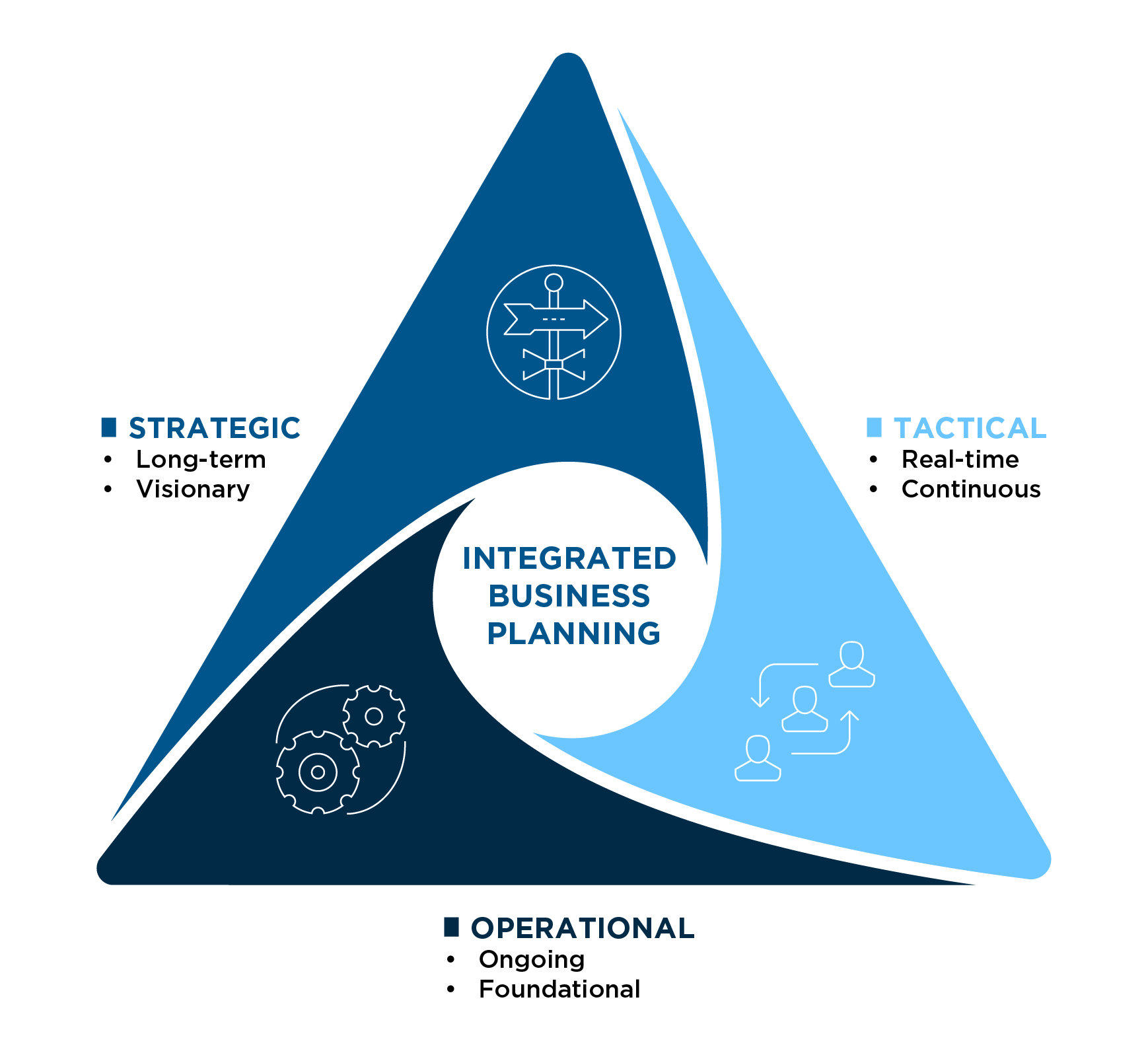
Align goals to organizational strategy
Strategic planning is where supply chain decisions connect to business value. When goals are explicitly tied to financial outcomes — cost-to-serve, working capital, service levels — leaders can make tradeoffs with confidence rather than reacting to pressure. The risk is losing sight of that connection under day-to-day operational pressure. The organizations that maintain supply chain performance through disruption are the ones that regularly step back to assess whether their decisions are still serving the broader strategy:
- What did this decision cost us — and was the tradeoff worth it?
Most organizations can answer the first part but not the second — because cost-to-serve and margin impact aren't visible until after the fact. - Is our supply chain reducing complexity or adding it?
Complexity typically grows through well-intentioned decisions made in isolation — new suppliers, new SKUs, new routes — without visibility into the downstream cost. - Are we creating value for the business, or just managing variability?
The difference shows up in whether improvements translate to financial outcomes or just operational metrics. - Does our current network position us for where the business is going?
A network optimized for last year's demand profile may already be misaligned with where growth is headed.